

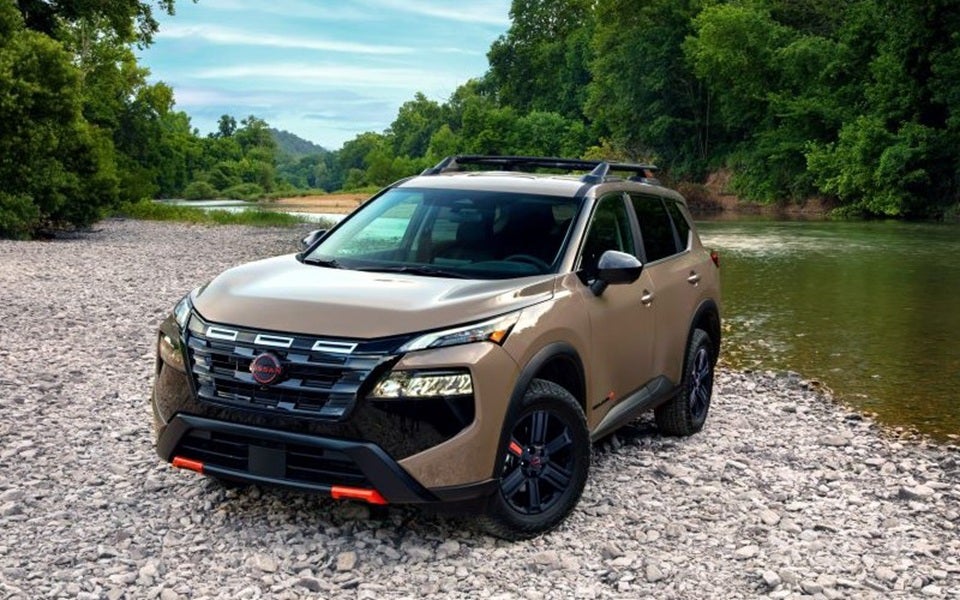
Nissan Rogue vs Honda CR-V
If you've been seeking a reliable sport utility vehicle (SUV) for your daily commutes around Avon, Plainfield, and Danville, Indiana, there are specific characteristics you may want to keep in mind.
These include good fuel economy if you’re planning on taking long road trips, interior amenities to ensure that everyone on board can remain nice and comfortable, and advanced technology elements that allow all occupants to enjoy their drives even more.
Two possible options out there are the Nissan Rogue and the Honda CR-V. So, you may ask yourself, “Should I buy a Nissan Rogue or Honda CR-V?”
To help answer that question, our team of experts here at Andy Mohr Avon Nissan has created this Nissan Rogue vs. Honda CR-V vehicle comparison.
Nissan Rogue vs. Honda CR-V: Quick Facts
To give you a preview of the information you’ll find throughout this comparison, we’ve supplied you with a quick look at how these models stack up to each other.
The results are as follows:
- 1.5L VC-Turbo 3-cylinder engine: The Rogue comes standard with a powerful and efficient 1.5L Variable Compression Turbo engine that produces 201 horsepower and 225 lb-ft of torque and has impressive highway MPG. Meanwhile, the CR-V comes standard with a 1.5L turbocharged 4-cylinder powertrain that generates 190 horsepower and 179 lb-ft of torque.
- Infotainment display: The Rogue has an easy-to-use 8-inch infotainment display, and higher trims offer a 12.3-inch touchscreen. However, the one in the CR-V starts at seven inches, with only a 9-inch screen available on upper trims.
- Divide-n-Hide® Cargo System: Another standout feature separating the Rogue from the CR-V is the Divide-n-Hide® cargo system. Found in the Rogue, this setup gives you a seemingly endless number of cargo variations to use. Lying items flat, making a shelf to easily separate goods, or placing valuables in a hidden compartment are all possibilities!
Rogue vs. CR-V: Standard Performance Specs
The Nissan Rogue has a 1.5L VC-Turbo® 3-cylinder engine paired with an Xtronic CVT® (Continuously Variable Transmission). With this pairing, this SUV can achieve up to an EPA-estimated 30 city/37 highway MPG.*
Meanwhile, the Honda CR-V uses a 1.5L turbocharged 4-cylinder engine paired with a CVT. While similar, there are some discrepancies for the Honda SUV, as it achieves an EPA-estimated 28 city/33 highway MPG in its gas configuration.
The variation in highway efficiency is more noticeable as you make your way through long, daily commutes or enjoy getting family and friends together for a distant weekend getaway.
Additionally, both vehicles offer the choice between front-wheel drive or all-wheel drive systems to easily handle any type of road or weather condition. The all-wheel drive arrangements used in each SUV do their best to monitor ever-changing road conditions.
For example, the Intelligent All-Wheel Drive setup in the Nissan Rogue can adapt to changing road conditions 30 times faster than the blink of an eye.*
With striking efficiency guiding you along your path, you can move with assurance, knowing your vehicle's traction will remain steady, even in inclement weather.
Nissan Rogue vs. Honda CR-V Driver-Assistance Safety Features
As technology grows and plays an ever-important part in modern vehicles, driver-assistance features become more and more prominent.
With the Rogue and the CR-V, you’ll see a lot of overlapping technologies.
For example, here’s a list of standard driver-assistance features in each SUV. While each brand may have a unique name for the system, its functions are identical:
- Lane Departure Warning
- Multi-angle, rearview camera systems
- Intelligent Forward Collision Warning
- Automatic Emergency Braking
The divide in standard features comes from Blind Spot Warning, a setup that Nissan offers in their base model that Honda doesn’t. With this system in place, you’ll be alerted to vehicles driving in your blind spot as you go to change lanes on a busy highway or clustered two-lane road!
Nissan Rogue vs. Honda CR-V Interior Features
The Rogue interior offers plenty of room for five people to stretch out, relax, and enjoy the ride. This is especially noticeable regarding the front row seats, which have 41.3 inches of front legroom in both models.
Each vehicle comes standard with cloth seats and offers leather seating in higher trims. They also both offer heated front seats to allow things to get nice and cozy on days when the weather gets a little cooler.
Nissan Rogue vs. Honda CR-V Tech Features
The Nissan Rogue and the Honda CR-V have plenty of technologies to help keep everyone on board connected and entertained for your entire ride, whether running errands or embarking on a much longer journey.
For example, they each come standard with Bluetooth® capability to stream audio or make hands-free phone calls.
The Rogue tech package also includes an infotainment system that displays all your media options on an 8-inch touchscreen.
Plus, you can connect your compatible smartphone to the car using Apple CarPlay® or Android Auto™ integration. This standard feature allows you to easily access your favorite smartphone apps, text messages, music playlists, navigation, and more without handling a single mobile device while you’re on the road.
On the other hand, the CR-V comes standard with a smaller 7-inch screen. Plus, it offers Apple CarPlay® or Android Auto™ integration starting on all trims.
Another dividing factor, when looking at standard technology in the Rogue vs. the CR-V, would be the inclusion of a Hands-free Text Messaging Assistant.
Nissan provides this handy technology in all of its Rogue trim levels, giving you easy, straightforward access to text messages, whether you receive them or send them.
For Honda, you’ll need to climb trim levels to get technology comparable to that found in the entry-level Rogue.
Rogue vs. CR-V Audio Systems
The Nissan Rogue makes it easier to stay connected to your vehicle and contacts on the go than the Honda CR-V does—which model provides a more appealing sound system? For audiophiles, having a straightforward, immersive sound setup goes a long way toward improving your daily commute.
The options in the Rogue and the CR-V appear similar on the surface, but a deeper analysis shows that Nissan has the edge.
First, each SUV tops out with a 9-speaker system. The sound systems should be the same, right? Well, not exactly.
The CR-V adds a subwoofer to its system, while the Rogue introduces dual-driver woofers. Given their position in the vehicle and their overall power, the dual-driver woofers amplify the subtler parts of a song, such as the bass.
Overall, the Bose® Premium Audio System of the Nissan Rogue is more refined and accessible than that of the Honda CR-V.
FAQs
Q: Which SUV offers a more efficient yet powerful engine?
A: The Nissan Rogue stands out with its 1.5L Turbo engine, which automatically adjusts to balance power and fuel efficiency. The Honda CR-V’s base engine delivers slightly less power, giving the Rogue the edge for everyday versatility.
Q: How does the driving experience compare to the Rogue and CR-V?
A: The Rogue’s turbocharged engine and finely tuned suspension create a quiet, refined, and composed ride, especially on highways. Drivers often find the Rogue to be more engaging and responsive behind the wheel.
Q: Which model has more advanced driver-assist technology?
A: Both SUVs include robust safety suites, but the Rogue features Nissan Safety Shield® 360 across all trims, so every model comes with Blind Spot Warning, Rear Automatic Braking, and Lane Departure Warning.
Test Drive the Nissan Rogue vs the Honda CR-V Today
To help you decide between the Nissan Rogue vs. the Honda CR-V, experience the options in person.
If you live near Avon, Plainfield, or Danville, IN, and want to get behind the wheel of the Rogue, all you have to do is contact us to schedule a test drive at Andy Mohr Avon Nissan today for drives out to Northgate Park.
* Fuel economy based on targeted 2026 EPA fuel economy estimates for 2026 Rogue – EPA data not available at time of publication. Targeted 2026 fuel economy 30 City MPG / 37 Highway MPG / 33 Combined MPG for Rogue S and SV FWD. 28 City MPG / 35 Highway MPG / 31 Combined MPG for Rogue S and SV AWD. 27 City MPG / 32 Highway MPG / 29 Combined MPG for Rogue Rock Creek AWD. 29 City MPG / 36 Highway MPG / 32 Combined MPG for Rogue SL FWD. 28 City MPG / 34 Highway MPG / 31 Combined MPG for Rogue SL and Platinum AWD. MPG estimates based on Nissan internal testing results, subject to EPA confirmation. Actual mileage may vary with driving conditions. Use for comparison only.
** SOURCE – Nissan USA